
With the flood of new people coming online and trying to learn about the world of BDSM, there has been a lot of confusion from many new submissives about what behavior is normal and what is abusive.

When in a BDSM relationship the key question between Dominance or abuse, is what's the purpose, and more importantly, does it serve any sort of benefit. BDSM is supposed to be a chance to learn about yourself and the person you're involved with. If nothing comes of an experience other than emotional pain, then it can very easily be considered abuse if the emotional pain wasn't wanted/consensual.
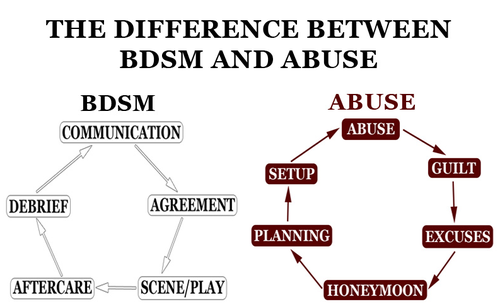
Knowing the signs of an abusive individual may help you avoid getting into emotional abuse in your future relationships. If your partner humiliates or insults you often, or isolates you from the people you love, it might be a clear indication that your partner may be more into the power trip than into pleasuring you by acting out your fantasies. You have the right to be treated with respect, you have the right to say no and leave.

Emotional and mental abuse can often be found in many online relationships. While it may seem very obvious to people that have been in the Lifestyle for a while, new submissives might not realize what's going on, or may think that it's just a normal part of a healthy D/s relationship.
I won't get into specifics because there are too many different scenarios that could happen. Instead, here are some general things to look out for and evaluate closer if they happen to you on a regular basis in your own BDSM relationship.


Mental and Emotional Abuse in a BDSM Relationship
When in a BDSM relationship the key question between Dominance or abuse, is what's the purpose, and more importantly, does it serve any sort of benefit. BDSM is supposed to be a chance to learn about yourself and the person you're involved with. If nothing comes of an experience other than emotional pain, then it can very easily be considered abuse if the emotional pain wasn't wanted/consensual.
Knowing the signs of an abusive individual may help you avoid getting into emotional abuse in your future relationships. If your partner humiliates or insults you often, or isolates you from the people you love, it might be a clear indication that your partner may be more into the power trip than into pleasuring you by acting out your fantasies. You have the right to be treated with respect, you have the right to say no and leave.
Emotional and mental abuse can often be found in many online relationships. While it may seem very obvious to people that have been in the Lifestyle for a while, new submissives might not realize what's going on, or may think that it's just a normal part of a healthy D/s relationship.
I won't get into specifics because there are too many different scenarios that could happen. Instead, here are some general things to look out for and evaluate closer if they happen to you on a regular basis in your own BDSM relationship.
Silence
This can come in two main forms:
(A) Silence when the Dominant doesn't allow the submissive to initiate any contact between them, making it a rule that any and all contact will come from him/her. This goes against one of the very foundations of a BDSM relationship - open, honest, two way communication. If the submissive feels they can't contact their Dominant even through email, they will feel alone, isolated, depressed, confused, and often unwanted. If the sub feels this very often, then they are being abused.
(A) Silence when the Dominant doesn't allow the submissive to initiate any contact between them, making it a rule that any and all contact will come from him/her. This goes against one of the very foundations of a BDSM relationship - open, honest, two way communication. If the submissive feels they can't contact their Dominant even through email, they will feel alone, isolated, depressed, confused, and often unwanted. If the sub feels this very often, then they are being abused.
(B) Silence as punishment. Silence, or ignoring a submissive for punishment, is considered by some Dominants as an acceptable form of punishment. But a growing movement in many BDSM circles considers this to be a form of emotional abuse. A Dominant should know that a submissive will already punish themselves harsher and longer than their Dominant will if they make mistakes. Pleasing a Dominant and having him/her show pride in their submissive is one of the greatest pleasures a sub receives. If the Dominant ignores the sub to teach them a lesson, it only teaches them to feel alone, stupid and unworthy on top of whatever mental punishment they usually inflict on themselves.
Extensive Punishment
Most submissives get punished for various reasons from time to time. Some need more punishment than others while others crave punishment and try to trick the Dominant into it by being brats. If you are not a brat but get punished for every little mistake instead of the mistake being corrected at first, then this could be a form of mental abuse. If you constantly feel unworthy, stupid and unwanted because of the way and frequency your Dominant punishes you, then you need to step back from the relationship and look at it closer to determine if it is something you wish to continue with.
Manipulative Behavior
If your Dominant uses language or phrases in order to force you to perform an action against your will, that is mental abuse. An example could be telling the submissive they are a bad sub if they don't send naked pictures to their Dominant.
Threatening to End the Relationship
If a Dominant consistently uses the threat of ending the relationship for almost any reason, that is emotional and mental abuse. This is not something that should ever be used unless the Dom or sub is absolutely sure they want to leave the relationship.
Fear
Any threat or punishment that keeps the submissive in an almost constant state of fear is emotional abuse. If a Dominant is using fear to keep a submissive in line or in a relationship, the submissive should leave that relationship as soon as possible. In BDSM, there is good and bad fear. But to use fear against your submissive as a form of control constitutes abuse.
If you experience any of the above items, in any type of form, I urge you to step back and evaluate your relationship with your Dominant. Make sure you are not trapped in a constant state of fear, uncertainty, isolation, or unhappiness. Being in a real BDSM or D/s relationship should make you feel wanted, appreciated, and not alone.
Afterthoughts:
After speaking to my Padrone about this article, he reminded me that there are some types of relationships in the BDSM world that are based on consensual abuse such as all different types of humiliation, as well as S and M based relationships that are extremely sadistic or masochistic in nature. Remember that every BDSM based relationship is different and diverse people have many diverse needs, so it is ultimately up to you to decide what type of relationship you want and need.
Afterthoughts:
After speaking to my Padrone about this article, he reminded me that there are some types of relationships in the BDSM world that are based on consensual abuse such as all different types of humiliation, as well as S and M based relationships that are extremely sadistic or masochistic in nature. Remember that every BDSM based relationship is different and diverse people have many diverse needs, so it is ultimately up to you to decide what type of relationship you want and need.
Mental and Emotional Abuse in a BDSM Relationship
Share this post - support us:
If you don't already know, bondage is the activity of restraining people for mutual erotic pleasure-tying someone up, locking them in chains, cuffs or collars, or using more esoteric forms of restraint--it's fun, can be incredibly hot and is a huge turn-on for a lot of people.

Per one well known source, the Kinsey Institute, 12% of females and 22% of males respond erotically to S&M. Studies vary, but another one (Lowe, 1983) had it that 5-10% of the U.S. engages in SM for sexual pleasure on at least an occasional basis. It also said that 11% of men and 17% of women reported at least trying bondage, so it follows that these people thought it might be a turn on. It is nothing new, but seems to be growing.
Just look at the massive (and growing) amount of bondage-related images in pop culture these days--movies, TV and music videos--and you can see that people are awakening to this side of sexuality. If you ever found yourself watching a movie with slightly more than causal interest when the girl or guy was tied up or had a collar locked around their neck or was locked in a prison cell, then you probably know a bit about this already.

Bondage as a sexual activity first came to notice in Japan in the late Edo period. Generally recognized as "father of Kinbaku" is Seiu Ito, who started studying and researching Hojōjutsu is credited with the inception of Kinbaku, though it is noted that he drew inspiration from other art forms of the time including Kabuki theatre and Ukiyoe woodblock prints. Kinbaku became widely popular in Japan in the 1950s through magazines such as Kitan Club and Yomikiri Romance, which published the first naked bondage photographs. In the 1960s, people such as Eikichi Osada began to appear performing live SM shows often including a large amount of rope bondage, today these performers are often referred to as Nawashi (rope master) or Bakushi (from kinbakushi, meaning bondage master).
The ropes used come in a variety of materials and length. Japanese bondage traditionally uses natural fibers such as hemp and jute which are cut to approximately 25 foot lengths. American-style bondage typically uses longer ropes that span a wider variety of materials.

An important part of rope bondage is the rope dress, which is not of itself a form of restraint, but may be used either by itself as an adornment, or as a basis for restraining bondage.
There are two main names used in the BDSM community today for rope bondage - Kinbaku and Shibari. There is much discussion about the distinction between shibari and kinbaku, and whether one term is more appropriate than another. One modern distinction which is gaining popularity is that shibari refers to purely artistic, aesthetic rope, whilst kinbaku refers to the artistic, connective, sensual, sexual practice as a whole.

A traditional view is that the term 'shibari' is a wrong Western Japonism. The word denotes tying in Japanese, but in a generic way, and traditionally not in the context of bondage. The names for many particular ties include 'shibari', but it is not traditional to call the entire activity that way. Instead, Kinbaku is the term for artistic or erotic tying within traditional Japanese rope bondage circles.
However, this is a somewhat hidebound definition and the word shibari is now increasingly being re-imported from the West to Japan, as the tying communities are very much interconnected. Most Japanese kinbakushi do not object to the term shibari, as it's common vernacular in the global community.

Kinbaku Technique
Kinbaku means 'tight binding'. Kinbaku is a Japanese style of bondage or BDSM which involves tying up the bottom using simple, yet visually intricate patterns, usually with several pieces of thin rope. The allusion is to the use of hemp rope for restraining prisoners, as a symbol of power, in the same way that stocks or manacles are used in a Western BDSM context.
Traditional Kinbaku is based on fairly specific rope patterns, most of them derived from Hojojutsu ties. Of particular importance are the Ushiro Takatekote (a type of arm box tie), which forms the basis of most Kinbaku ties, and the Ebi, or "Shrimp", which was originally designed as a torture tie but today makes the bottom vulnerable for more pleasant forms of play.

For historic reasons, Kinbaku uses very few knots, sometimes none at all, or only a cow hitch or an overhand knot. This requires rope with high friction. According to Sensei Nawa Yumio in his 1964 classic book on Torinawa, knots on a person was regarded as extremely disgraceful, something some would regard as worse than death. Restraints with no knots were not considered "bondage" and there was no shame in such; therefore, "wrappings" were used.
A Feeling of Wonder
So what does it actually feel like to be tied in a technique that’s so infused in history, secrecy, sensuality and mysticism? The tension in the rope, controlled entirely by the rigger, becomes a link between the two of you, so being tied feels like an all-over embrace. As the cords tighten around you the rope artist actually employs Shiatsu techniques (a type of Japanese massage) on specific pressure points. The roughness of the natural fibers in hemp or jute rope gives you goose-bumps as it slowly trails across your skin.

You fall into a trance-like state of deep relaxation and euphoria known as ‘rope space’, which for me feels similar to ‘sub space’ but without the sexual charge. Flooded with endorphins, your muscles relax and your speech slurs, if you can speak at all. You submit yourself entirely to the ecstasy of being bound. And all that, just from a piece of rope in the right hands - usually without any sexual touching at all.
Safety Considerations
There are several safety issues to consider when playing bondage games, concerning consent, abuse, and physical injuries. If you don't feel safe with something then don't do it, there are hundreds of other things you can do instead.

This is NOT something to try with someone you've just met. You really don't know whether they are trustworthy or not until you know them better, however charming they may seem at first.
- Never let a partner coerce or bully you into any sexual practice that you don't want to do. It's perfectly OK to say no, a decent lover will understand.
- Talk about it beforehand and discuss what you plan to do. Say what you will or will not allow. These rules and limits are sacred and must not be broken during the game.
- Have a safe word agreed before you begin. This is something that the passive partner can say if they want the other person to stop, a common safe word is 'enough'. The active partner must then stop what they are doing immediately, and release the passive partner within seconds.
- Never tie something around someone's neck unless it is a collar that's specially made for the purpose. There is a high risk of tissue damage, choking, or fatal strangulation. Similarly, gags are potentially dangerous.
- If someone is tied up, they must never be left alone. The active partner must make sure they are comfortable, breathing properly, and that nothing is cutting off their circulation.
- Do not try bondage in a remote place, just in case there is an accident that leaves the active partner injured and the passive partner tied up with no way of getting help.
- If you've never tried bondage before, don't go straight into anything that uses complicated equipment. This is for experts only and has extra safety issues that you may not understand.
- The rules of safer sex still apply. Use condoms for penetrative sex. Drink and drugs can cause you to seriously underestimate safety risks. Avoid intoxication.

Share this post - support us:


